
In today’s volatile financial landscape, credit and risk analysts are under increasing pressure to make faster, more accurate decisions—often with limited time and overwhelming amounts of data. Traditional models often fall short in capturing the early signs of distress or opportunity—especially when markets move faster than quarterly reports.
That is where Early Warning Signals (EWS) step in. By combining real-time sentiment analysis with a curated set of credit-specific signals, it is designed to save analysts time while improving decision quality. CreditX delivers real-time sentiment analysis on 16 credit relevant signals.
What does EWS provide? EWS provides real-time insights on signals, provides an EWS score, highlights critical alerts and events and helps you decode data to surface potential risks, pre-emptively. You can experience EWS with CreditX here.
In a world where markets shift in minutes and reputations can unravel overnight, relying solely on traditional credit monitoring tools is no longer sufficient. Credit risk analysts are often left reacting to events rather than anticipating them—putting portfolios, institutions, and reputations at risk.
Delayed Signals
Most credit monitoring systems depend on annual and quarterly financial statements, management information, updates from rating agencies, or lagging indicators. By the time a red flag appears in these sources, the damage may already be done. Analysts need tools that surface risk before it becomes obvious.
Time-Consuming Research
Analysts spend hours sifting through news, financials, and reports to validate a single insight. This manual process is not only inefficient but also unsustainable at scale.
Information Overload
With thousands of news articles, investor reports, and financial disclosures published daily, it’s nearly impossible for analysts to manually track every relevant signal. Valuable insights are often buried in noise, leading to missed opportunities or late reactions.
False Positives and Generic Alerts
Many existing systems flood users with alerts that lack context or relevance. These false positives not only waste time but also erode trust in the system—forcing analysts to double-check everything manually.
Lack of Sentiment Intelligence
Traditional models rarely account for market sentiment—a critical early indicator of credit risk. Negative sentiment in news or investor commentary often precedes financial deterioration, yet it’s frequently overlooked in conventional credit models.
To meet the demands of today’s fast-moving credit landscape, analysts need more than just data—they need intelligence. That’s exactly what Early Warning Signals(EWS) from CreditX delivers.
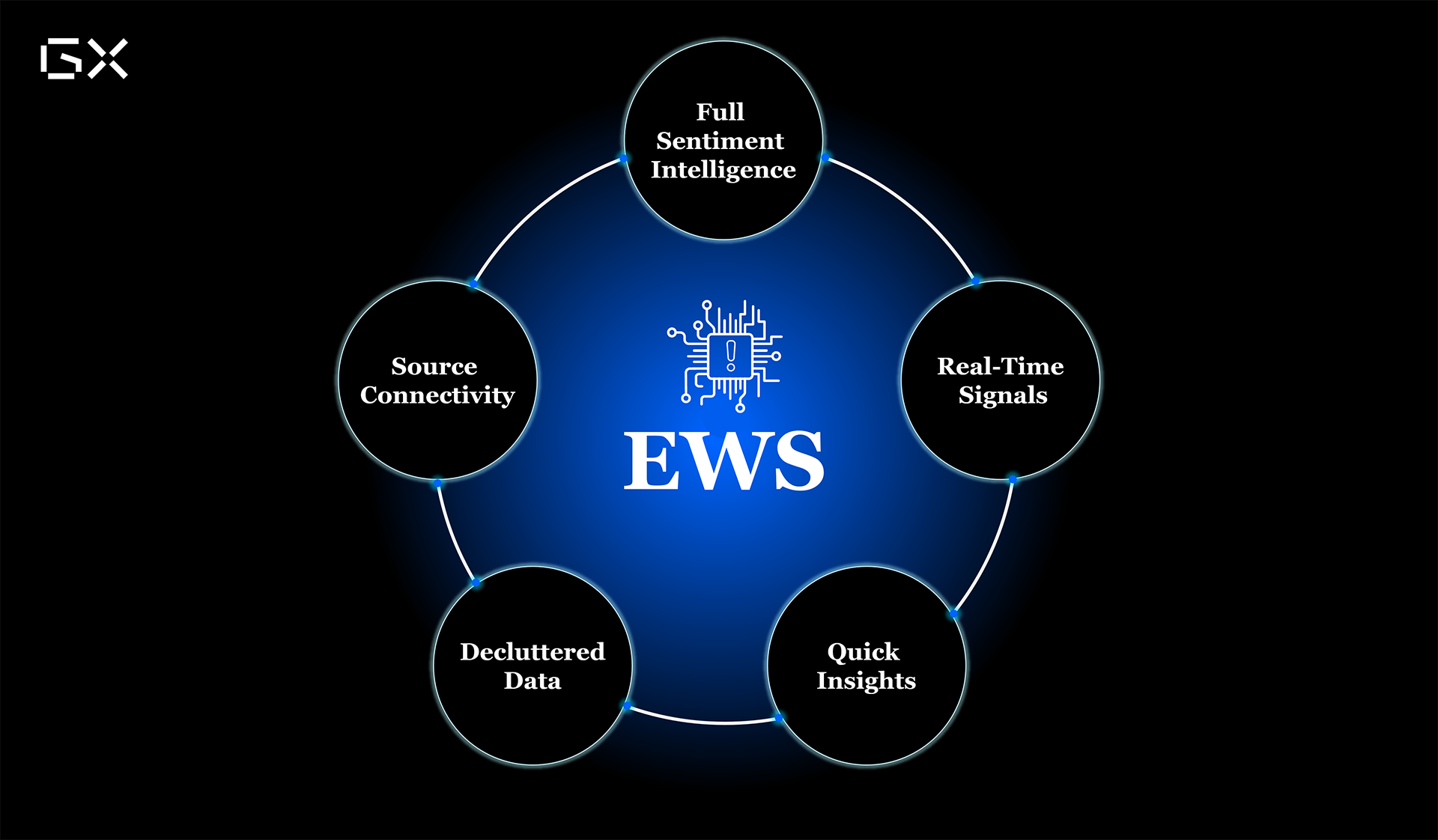
Built specifically for credit and risk professionals, CreditX combines real-time sentiment analysis, curated credit signals, and trusted data sources to help you detect risk before it escalates. It’s not just about alerts—it’s about actionable foresight.
Real-Time Signals, Tailored for Credit
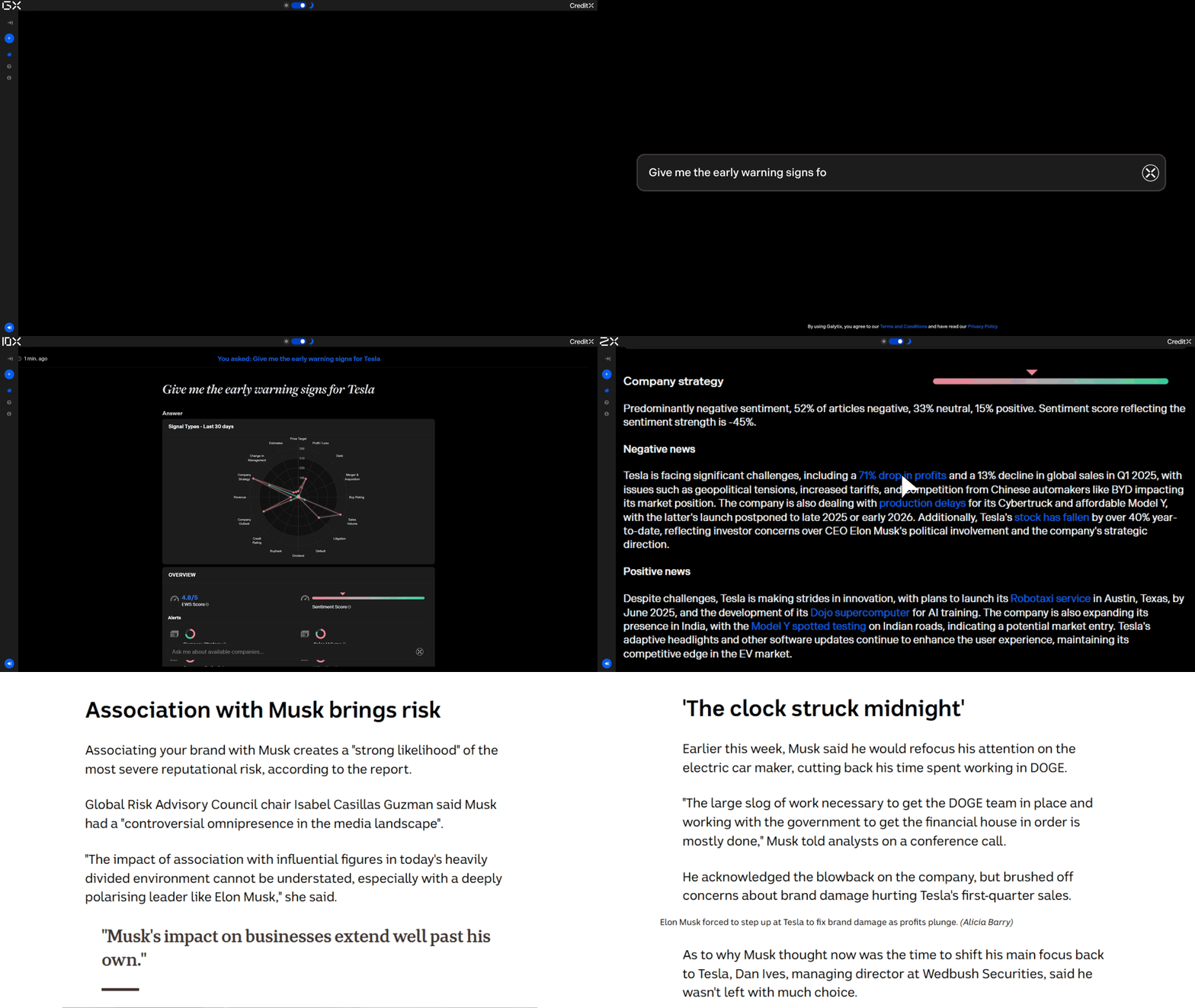
CreditX analyses sentiment across 16 credit-specific signals, drawing from sources like financial news, investor reports, earnings calls, and more. This isn’t generic NLP—it’s trained to understand the nuances of credit risk, from subtle shifts in tone to red flags in financial language.
Cut Through the Noise. Instantly.
Say goodbye to spending hours piecing together fragmented insights, EWS automates the heavy lifting — scanning management commentary, liquidity shifts, regulatory flags, and market volatility to surface only what matters most. Each signal is scored and prioritized, so you get a clear, real-time view of credit risk — all, without the research rabbit hole.
Clarity and Sources, in One Click
No more drowning in data? CreditX cuts through the clutter. Every alert comes with one-click access to the original source — whether it’s a filing, report, or article — so you can verify insights instantly without sifting through endless tabs.
No False Positives. Just True Signals.
We’ve engineered CreditX to prioritize precision. That means fewer noisy alerts and more meaningful insights. Our system is designed to surface only the signals that matter—so you can focus on what’s important, not what’s trending.
Full Sentiment Intelligence, No Sacrifices.
Early warning signals in CreditX is designed to provide a holistic real-time sentiment intelligence where it declutters the noise, maintains full source connectivity, and critically saves time for analysts, all without sacrificing accuracy. It is designed to surface risks and raise the red flags, and help you gain intelligence at a glance.
At Galytix, we believe the future of credit risk lies in proactive intelligence. CreditX empowers analysts with real-time insights and not just reports. Close your credit monitoring gap today — explore CreditX.
At the heart of CreditX’s Early Warning Signal is a powerful yet intuitive visualization: the Spider Web Chart. This chart transforms complex sentiment data into a format that’s instantly understandable, making it easier than ever for credit risk analysts to spot early signs of trouble or opportunity.
Ask a Simple Question, Get a Powerful Answer
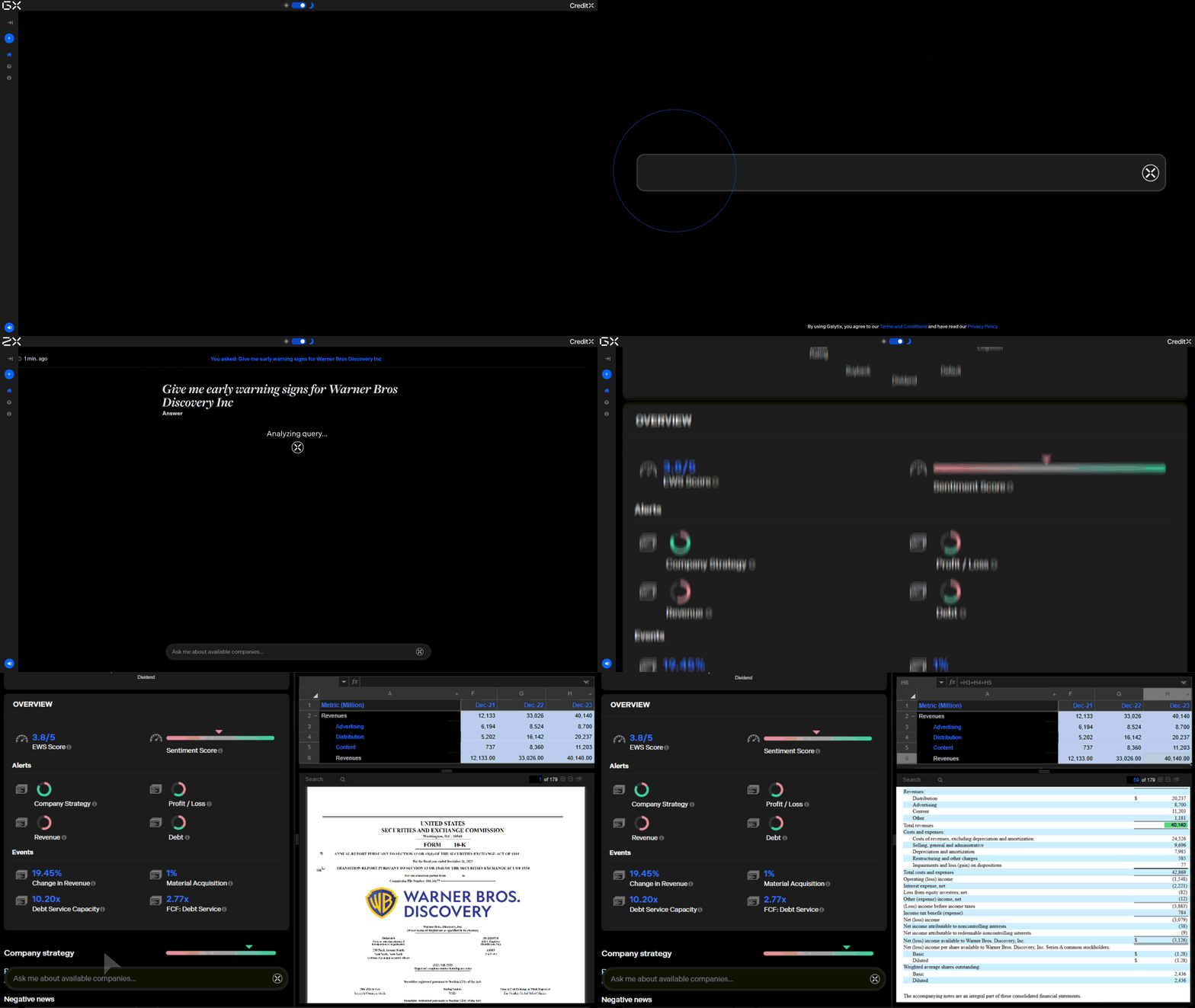
Whether you type “Give me early warning signs for Tesla” or simply “What is the sentiment around Alphabet,” CreditX understands your intent. Our system is designed to respond to natural language prompts, making it easy to access insights without needing to learn a new interface.
The Spider Web Chart: 16 Signals, One Unified View
Every company in our database is analysed across 16 credit-relevant signals—the core metrics that matter most in credit risk analysis. These include indicators like liquidity, leverage, governance, regulatory risk, and more.
Each signal is plotted on the perimeter of the spider web chart, with two key visual cues:
Red vs. Green Lines:
These lines represent the prevailing sentiment for each signal.
Red = Negative sentiment
Green = Positive sentiment
A chart with more red lines indicates a company facing potential headwinds, while more green lines suggest stability or improvement.
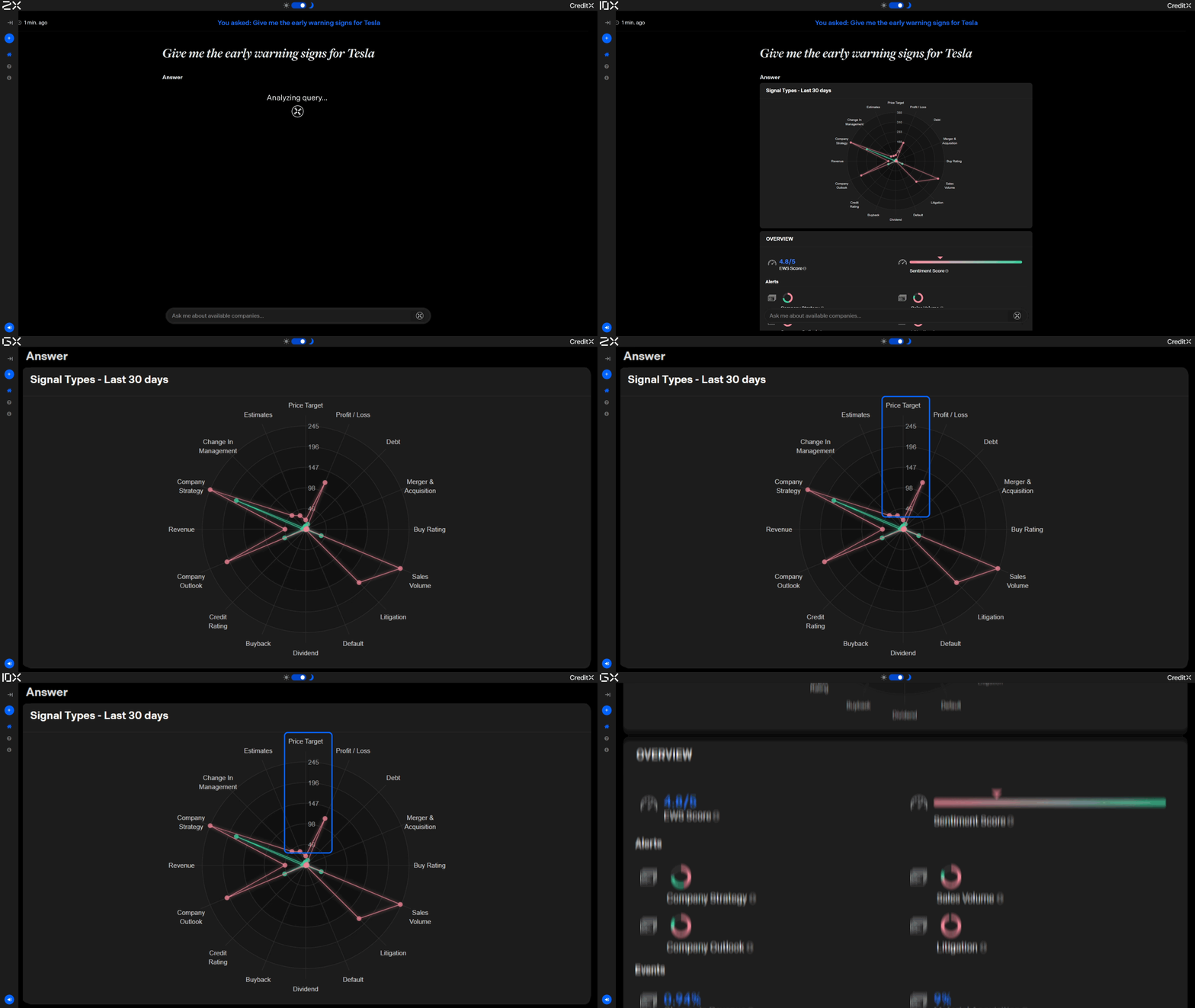
Signal Intensity:
The closer a line reaches the edge of the chart, the stronger the sentiment—based on the number of alerts detected for that signal. This lets analysts gauge not just the nature of the sentiment (positive/negative), but also its magnitude.
The Overview: From Visuals to Verdicts

Immediately following the spider web chart is the Overview section, which distils sentiment into two key metrics:
EWS Score (0–5): A proprietary score that reflects the volume and sentiment of credit-related news over the past 30 days. This is a weighted average of all articles across all signals. A higher score indicates increased credit-related activity, which could potentially signal an elevated risk or volatility, however this metric needs to be understood within the context of the next metric as well.
Sentiment Divergence Scale: A horizontal bar that shows the percentage of positive vs. negative sentiment across all 16 signals. This gives analysts a quick sense of whether the overall tone is optimistic, neutral, or concerning.
In order to understand the two together, think of them in this context:
EWS score = Volume + sentiment of articles for all signals.
Sentiment score = only signifies sentiments of articles for all signals.
We are showing sentiment score separately because sometimes articles can be lesser in quantity, but sentiment strength can be too strong, which results into a high early warning score. It is best to check both to understand the sentiment correctly, and not in isolation of each other.
Alerts: Focused Insight on What Matters Most
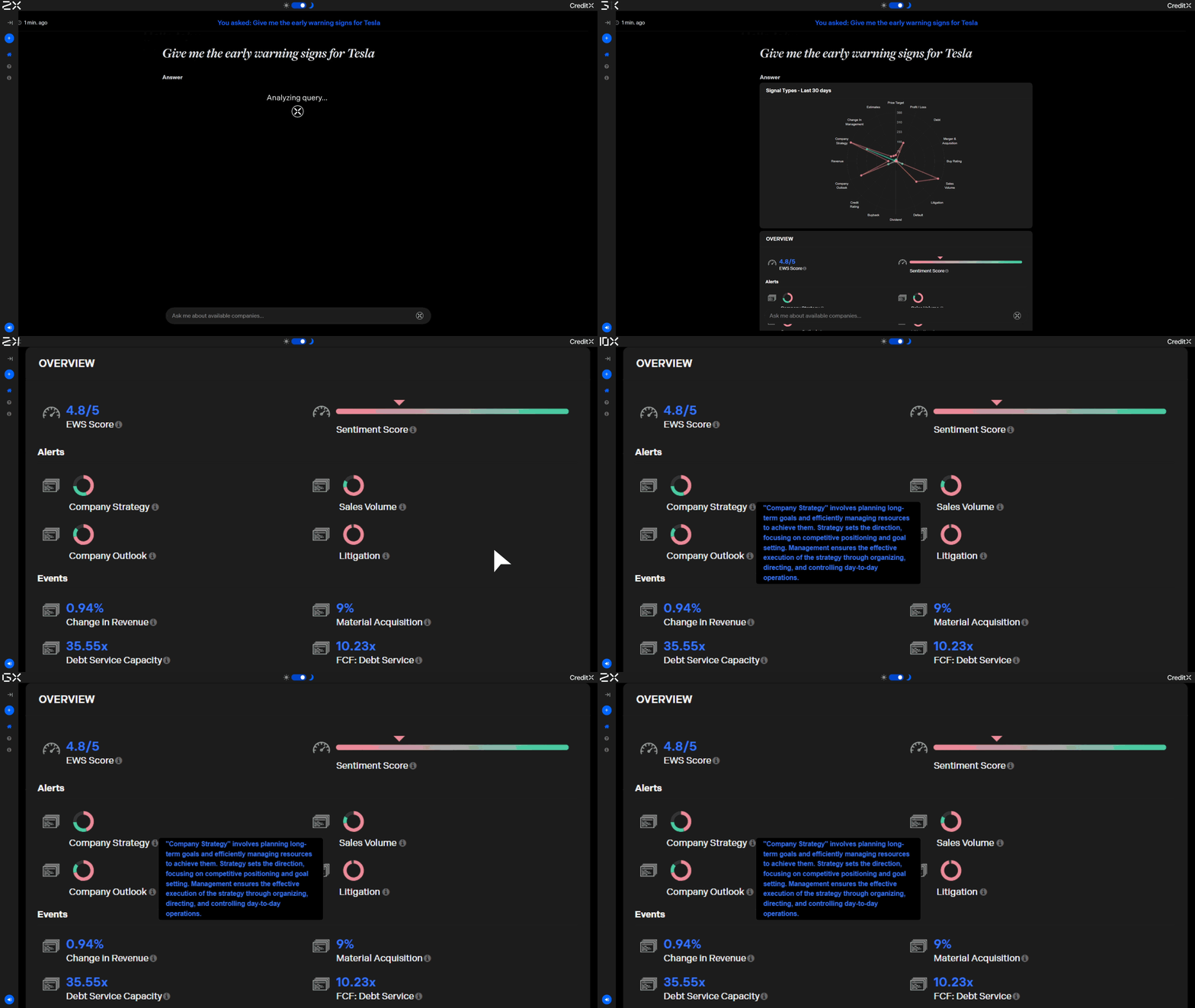
It is important to note that each metric in the overview sections is colour coded with a threshold value, and depending on the value it would either turn blue or red. In order to help analysts zero-in on the most relevant risks, CreditX highlights the top 4 signals with the highest volume of alerts. These are visualized using pie charts that show the balance between the positive and negative sentiments for each signal.
Each pie chart is important, by simply hovering over the info icon you can see what that alert represents and why it is important for you to take it into account.
The alerts are dynamic and flexible, adapting to the company’s unique risk profile and current market context.
These help you experience the “intelligence at a glance,” a goal with EWS, making sure that you can understand market perceptions without diving into manual research.
Finally, the Events section captures material developments that could impact a company’s creditworthiness. These include:
Change in Revenue (percentage)
Material Acquisition (percentage)
Debt Service Capacity (times)
FCF to Debt Service Cost (times)
While sentiment and signals offer powerful early indicators, CreditX also grounds its analysis in hard financial events—the kind that directly impact a company’s credit profile. The Events section highlights four critical metrics that help analysts assess a company’s financial health and operational stability:
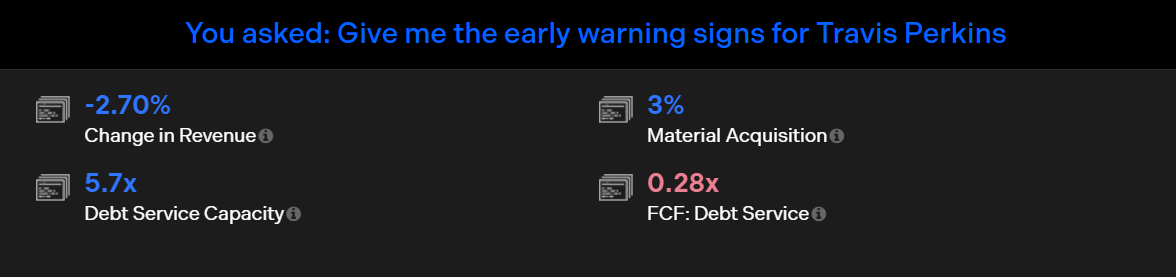
When we look at the 4 key event metrics of Travis Perkins Plc as a use-case example to understand them at a deeper level, we can observe that the EWS feature has correctly highlighted the low FCF for the organization, ensuring that analysts are aware and also pay attention to hard events, not just sentiment—providing a well-rounded view of both perception and performance.
To give analysts a deeper understanding of what is driving the sentiment, CreditX provides a signal-by-signal breakdown—ranked by the number of alerts detected for each signal. This section allows you to drill down into the most active credit indicators for any company and understand the narrative behind the numbers.
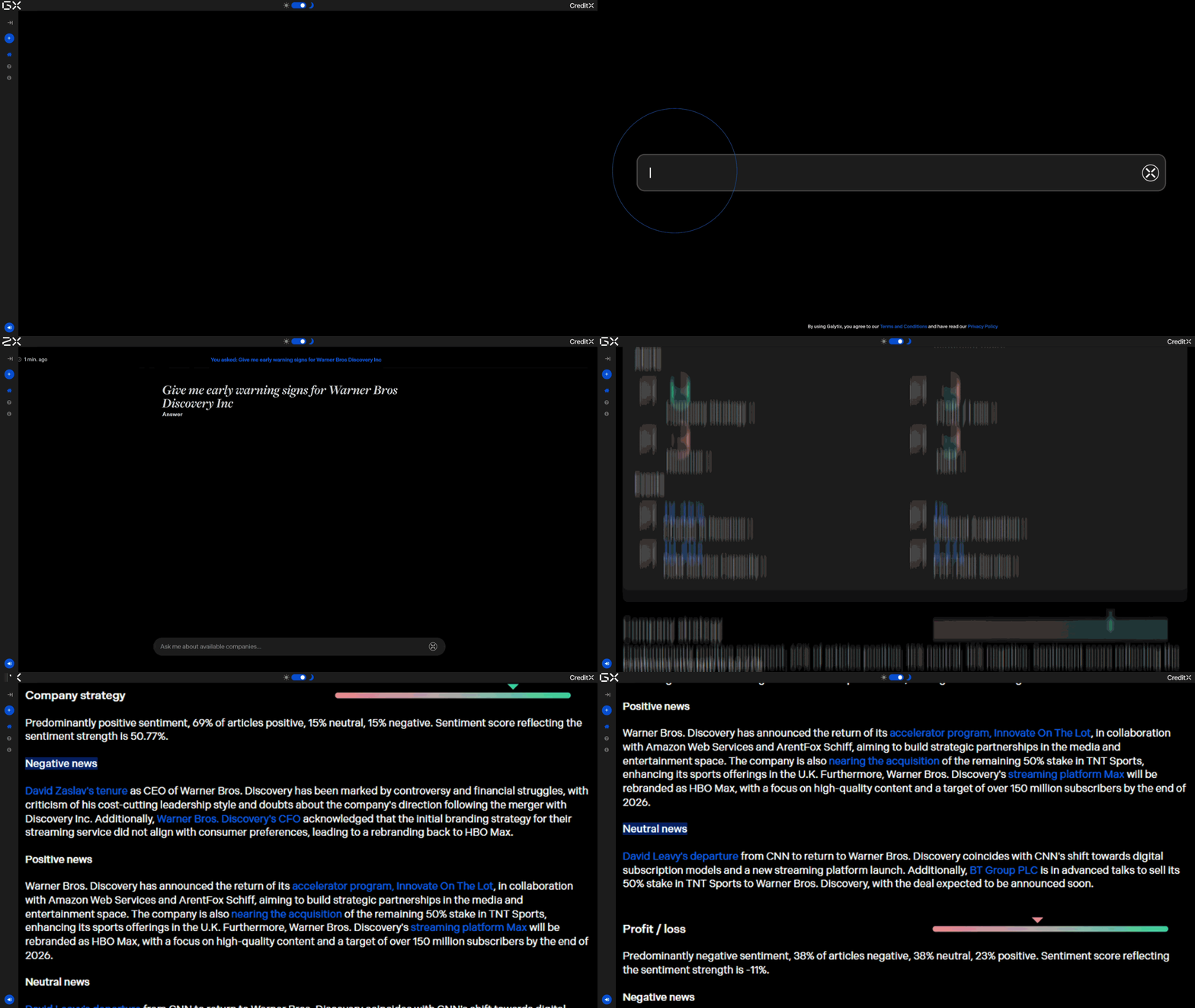
Each Signal Includes:
A sentiment divergence scale (horizontal bar) showing the balance of positive, negative, and neutral sentiment
A summary of sentiment distribution (e.g., 50% neutral, 25% negative, 25% positive)
A sentiment strength percentage indicating the strength and direction of sentiment (e.g., –5%)
A breakdown of news alerts, categorized into:
Negative news
Positive news
Neutral news
This level of granularity ensures that CreditX does not just tell you what is happening—it shows you why, with full transparency and traceability. Every claim in this section is backed by a source—whether it is a news article, investor report, or financial disclosure. Analysts can click through to verify the information and explore the context behind each alert.
For institutional users, CreditX goes even further:
Data Integration: Connects seamlessly with your bank’s internal and external data sources.
Multi-Level Analysis: Surfaces insights at the counterparty, sector, and sub-sector levels.
Human-in-the-Loop: Ensures high accuracy and relevance, minimizing false positives.
Smart Notifications: Get alerted when a counterparty needs review—based on time since last check or new developments. Customize what triggers alerts, how often they are sent, and who receives them.
As financial markets grow more complex and interconnected, the need for real-time, intelligent credit monitoring has never been greater. Traditional tools are no longer enough. Analysts need systems that not only keep up—but stay ahead.
We are just getting started—and we want you to be part of what’s next.
Explore our platform today and experience the power of our Early Warning Signals firsthand.